Written by Harrison Andrews, Mortgage Adviser, The Mortgage Broker
Book a free appointment with Harrison, here.
If you are self-employed and thinking about buying a home, January is one of the most useful moments in the year to stop guessing and start planning.
Not because you should rush into a purchase, but because January is when the previous year finally closes. The work is done, the invoices are raised, and the broad picture of income is no longer speculative. For self-employed buyers, that shift from estimates to evidence is critical. Mortgage planning only works when it is built on numbers lenders will recognise.
January is the point where conversations about buying a home move from “roughly” and “hopefully” to something far more practical.
In this guide, “self-employed” refers to both sole traders and limited company directors, who are assessed slightly differently by lenders but benefit equally from early planning.
Get StartedStep 1: January income clarity and why it matters
By January, most self-employed buyers are in one of three positions. Their accounts are finalised, they are very close to being finalised, or their accountant can give a reliable projection that is unlikely to change materially. That alone creates an advantage. It allows you to discuss borrowing based on what a lender is likely to accept, rather than what you would like them to accept. The distinction matters more for the self-employed than for employed applicants, because lender interpretation is just as important as headline income.
This is often the moment buyers realise that their income is either stronger, weaker, or simply different from how they assumed lenders would see it.
Step 2: How lenders interpret self-employed income behind the scenes
One of the biggest misunderstandings in self-employed mortgage planning is the idea that all lenders assess income in the same way. They do not. Most lenders will look at the last two years, but what they do with those figures varies. Some average them. Some place more weight on the most recent year if income is increasing. Others are cautious if there is volatility, even when overall income is healthy.
For limited company directors, the picture becomes more nuanced. Salary and dividends are usually the starting point, but some lenders will also consider retained profit if the business is stable and well evidenced. Others will ignore it entirely. This means two applicants with identical accounts can receive very different outcomes depending on lender choice.
January is when you can identify which lenders align with your structure and income pattern, rather than discovering misalignment halfway through an application.
Speak with an adviser today!
Request a call back
Step 3: Turning income into a borrowing range
Once lender assessment is understood, the next step is translating income into something tangible: a borrowing range that actually works.
This is where expectations are either confirmed or corrected. A stable income across two years tends to support consistent borrowing. Improving income can open higher ranges with the right lenders. A dip in one year does not automatically end plans, but it often leads to more cautious calculations unless recovery is clearly evidenced.
Understanding this early answers a crucial question: what price range makes sense before emotions get involved?
Without this step, buyers often browse properties based on aspiration rather than affordability, which leads to disappointment later.
Here’s a simple illustration.
| Declared income | Likely lender view | Rough borrowing impact |
| £40k then £40k | Average used | Stable borrowing |
| £40k then £48k | Latest or average | Higher potential |
| £48k then £40k | Average | More cautious lending |
This step answers a key question early:
What price range should I realistically be looking at?
Step 4: January’s hidden advantage – planning the current tax year
January is not just about looking backwards. It is early enough in the tax year to influence how the current year will eventually appear to lenders.
This is where self-employed buyers have an advantage if they act early. Decisions around drawings, dividends, retained profit, or expenses can shape how income is presented when accounts are assessed in future years. This is not about paying unnecessary tax. It is about understanding how business decisions today affect mortgage options tomorrow.
Leaving this until later in the year removes flexibility. January keeps options open.
Step 5: Seeing the self-employed buying journey clearly
For many self-employed buyers, the process feels confusing because the steps are unclear. January is where the sequence becomes visible.
Income is understood. Lender options are mapped. Borrowing ranges are confirmed. Only then does house hunting begin. When this order is followed, offers are stronger, decisions are calmer, and applications are less stressful.
The difference is not speed, but confidence.
Putting this into a simple flow helps.
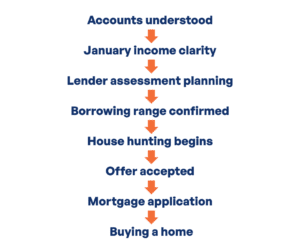
January sits right at the point where the journey stops being vague and starts being structured.
Step 6: When house hunting should actually begin
Once you know:
- how lenders will view your income
- what borrowing range that supports
- what price bracket makes sense
house hunting becomes far more straightforward.
You’re no longer browsing everything and hoping it works. You’re viewing properties that fit both your lifestyle and your finances.
That makes offers stronger and decisions calmer.
Step 7: The costs to expect as you move forward
From this point onward, the buying costs are the same as any UK buyer – but knowing when they appear helps.
| Stage | Typical UK costs |
| Mortgage application | £0-£1500* |
| Valuation | £0-£400 |
| Survey | £500-£1,500 |
| Conveyancing | £1,000-£2,500 |
| Moving costs | £300-£1,500 |
Planning in January helps ensure these costs appear once, not repeatedly through failed attempts.
*Upfront mortgage costs can vary a lot depending on the lender, product and individual situation; exact fees can only be confirmed once everything’s been reviewed.
Step 8: Applying with confidence, not hope
By the time a mortgage application is submitted, January planning means very little is unknown. Income has already been sense-checked. The lender fits the applicant’s profile. Expectations are grounded in reality.
This is why applications planned early often feel smoother. Not because lenders work faster, but because there are fewer surprises to slow things down.
Speak with an adviser today!
Request a call back
Step 9: From planning to purchase
After this point, the journey becomes familiar.
Legal work progresses. Surveys are carried out. Contracts are exchanged. Completion follows.
The difference for self-employed buyers who plan early is that this stage feels like execution, not uncertainty.
The simple takeaway
For self-employed buyers, January isn’t about rushing into buying a home.
It’s about setting the journey up properly.
January is the moment where:
- income becomes clear
- lender options can be mapped
- borrowing ranges make sense
- and house hunting can begin with confidence
That’s why January is such a turning point for self-employed mortgage planning.
FAQs: Self-Employed Mortgage Planning
No. January is often early enough to have a meaningful conversation using near-final figures or accountant projections. Early discussions help shape realistic expectations before anything is submitted.
No. Each lender has its own criteria, which is why planning matters. Some favour consistency, others reward growth, and some are more cautious with fluctuating income.
Not necessarily. Many self-employed buyers can borrow similar amounts to employed applicants, provided their income is clear, consistent, and structured correctly for lender assessment.
A dip doesn’t automatically mean a decline. Lenders may still average income, or a broker may guide you toward lenders that focus on the most recent year if recovery is evident.
For self-employed buyers, earlier is usually better. Planning in January can be 6–12 months ahead of buying, which allows time to position income correctly without pressure.
Yes. Decisions around drawings, dividends, retained profit, or expenses can all influence how income appears to lenders when assessed in future years.
Yes. Limited company directors are often assessed on salary and dividends, and sometimes retained profit. Understanding which lenders suit your structure is key.
Not always. Accounts are prepared for tax purposes, while lenders look at affordability and sustainability. A broker helps translate one into the other.
It can be. Without clarity, buyers may view properties that aren’t achievable, leading to wasted time, rejected offers, or failed applications.
Sometimes. Adjusting structure, timing, or lender choice can improve outcomes even when headline income stays the same.
Yes. When income, lender choice, and expectations are already aligned, applications tend to progress with fewer delays or surprises.
No. Even buyers planning 12–24 months ahead benefit from early clarity, as it allows time to adjust rather than react.
Call Us  0800 0320 316
Or Book a Free Mortgage Appointment
You can request a free, no-obligation mortgage review with a qualified adviser now.
No mortgage offer, no broker fee.
Author: Harrison Andrews, Mortgage Adviser


 View all posts by Harrison Andrews